Now Accepting New Patients · Complimentary Implant Consultations
Advanced Anchorage Techniques

Atrophic Jaw Solutions

For patients told they "don't have enough bone for implants" — the Advani Implant Institute offers the full range of advanced anchorage techniques that work where conventional implant placement won't. Most patients given a "no" elsewhere become candidates here.

No 9-Month Wait
Skip Most Bone Grafting
Same-Day Teeth Possible
X-Nav Guided
At a Glance
Treatment Options
  • Pterygoid Implants Available
  • Trans-Sinus Available
  • Palatal Approach Available
  • Nasopalatine Canal Available
  • Nasal/Piriform Rim Available
  • Zygomatic Implants Available
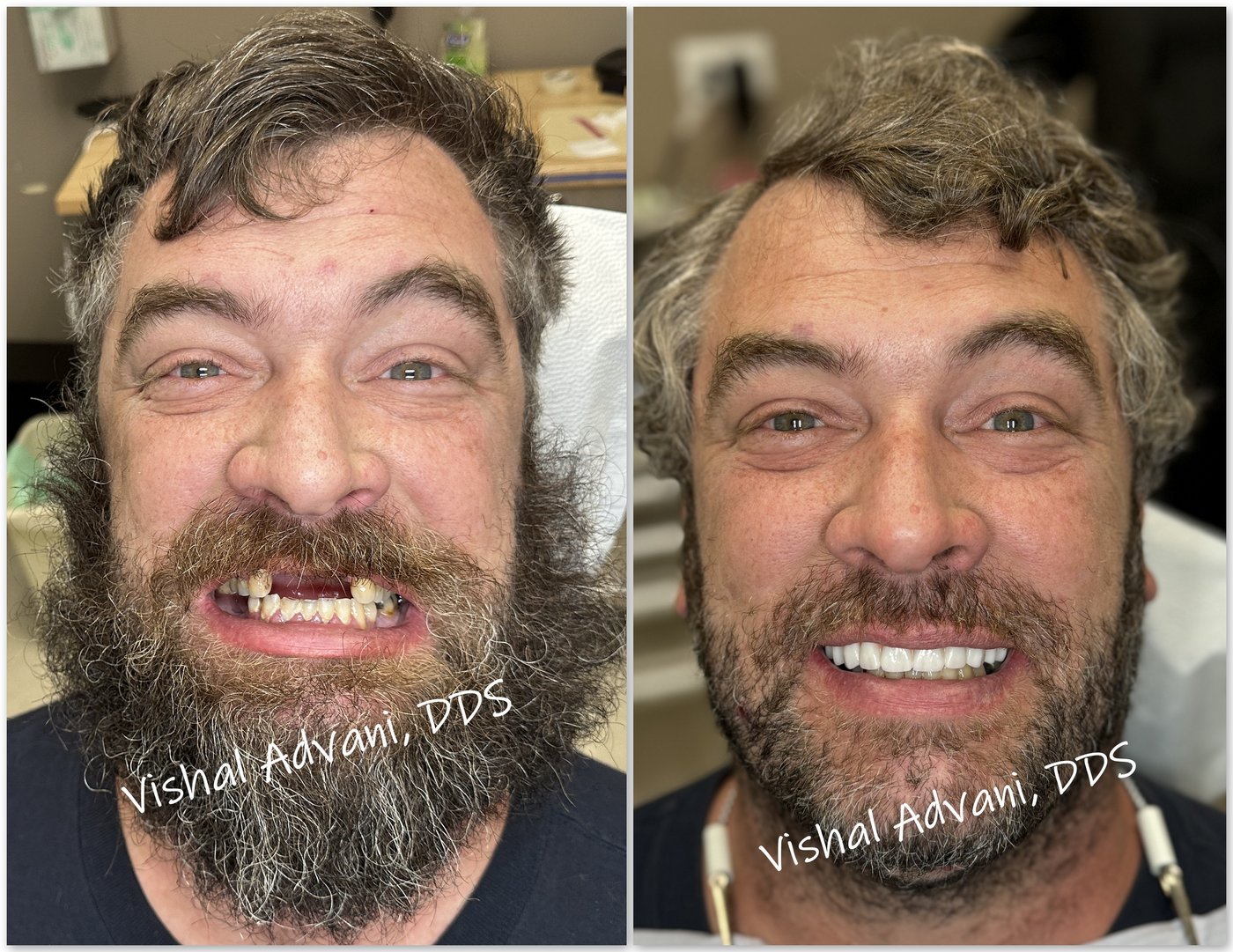
Full-arch atrophic jaw case completed
The Problem

If you've heard "you don't have enough bone"...

You're not alone. It's the most common conversation that brings new patients to the Advani Implant Institute. Someone has been told by another dentist or oral surgeon that they aren't a candidate for implants — that they need 9-12 months of bone grafting before any implant work can be considered, or that implants simply aren't possible for them.

For some patients, those answers may be correct. For most, they aren't.

The bone is there. It's just not in the place most dentists are trained to look for it.

The maxilla and mandible are surrounded by dense, predictable bone in multiple anatomical regions: pterygoid plates, the zygomatic process, the nasal floor, the piriform rim, even the nasopalatine canal. Implants can be anchored in any of these — but only by a surgeon trained in the specialized techniques required to do so safely.

That training is what the Advani Implant Institute is built around. Read our patient education guide on atrophic jaw treatment →
Six Advanced Anchorage Techniques

When the alveolar ridge isn't enough, this is what's possible.

The right technique for your case depends on your specific anatomy. A CBCT scan at consultation reveals exactly what bone you have to work with — and which approach will give you the best outcome.

01 / Most Common

Pterygoid Implants

Anchored in the pterygoid plate of the sphenoid bone, behind the maxillary sinus. Reaches dense native bone even when the sinus has fully expanded — eliminating sinus lifts in most full-arch cases.

Pterygoid deep dive →

02 / Single Visit

Trans-Sinus Implants

Implant placement that traverses the sinus to engage dense cortical bone above. Eliminates the wait time and morbidity of traditional sinus augmentation — single visit instead of staged treatment.

03 / Specialty

Palatal Approach

When buccal bone is too thin to support an implant, the palatal approach uses dense palatal bone as the anchorage point. Implant is angled medially to engage palatal cortical bone, providing strong support.

04 / Anterior

Nasal & Piriform Rim Anchorage

Implants engaging the dense cortical bone of the nasal floor and piriform rim. Particularly valuable for restoring front teeth in patients who've worn upper dentures for many years.

05 / Midline

Nasopalatine Canal Implants

The nasopalatine canal serves as an anchorage corridor for an implant in the midline of the upper jaw. Requires X-Nav dynamic guidance and significant surgical experience to execute safely.

06 / Most Severe

Zygomatic Implants

For the most severe upper-jaw atrophy where other techniques aren't sufficient. Anchored in the zygomatic (cheek) bone. Available at the Advani Implant Institute for select cases requiring zygomatic anchorage.

Timeline Comparison

What used to take 18 months now takes a single day.

The traditional approach for severe bone loss: sinus lifts, then 6-9 months of healing, then implant placement, then another 4-6 months of healing, then final restoration. 18-24 months total, multiple surgeries, multiple recovery periods.

Advanced atrophic-jaw techniques compress this dramatically. Single surgery. Same-day teeth in most full-arch cases. Final restoration in 3-6 months. The advanced techniques aren't just better surgically — they're life-changing in terms of how quickly patients can move on with their lives.

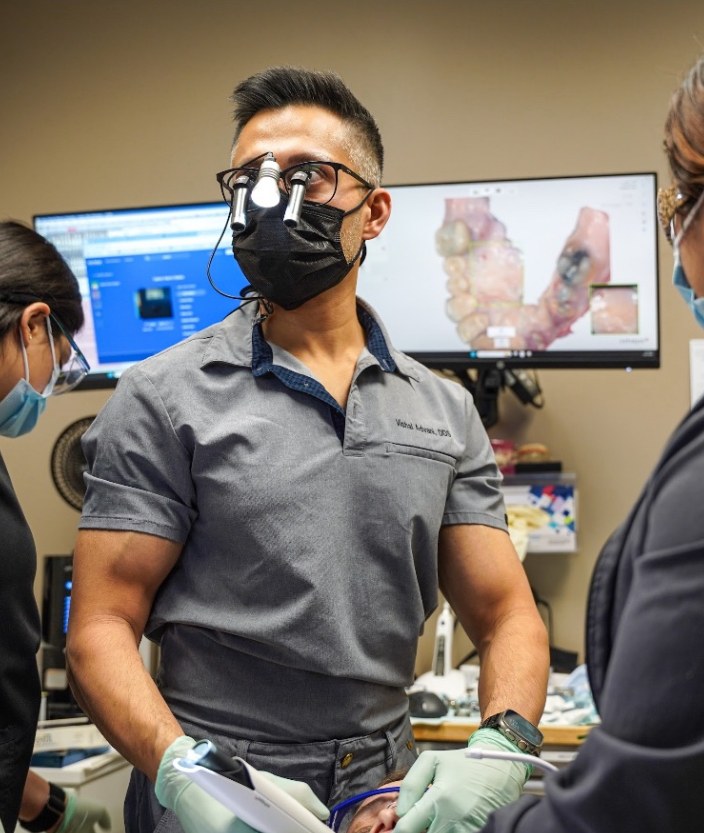
Dr. Advani in surgical setting
Why The Institute

Where these techniques are routine, not rare.

The procedures above are part of the standard surgical toolkit at the Advani Implant Institute — not exceptional cases done occasionally. Dr. Advani performs atrophic-jaw cases on a weekly basis and teaches these techniques to other dentists nationally through the Institute's CE program.

  • I

    High-volume specialty practice

    These cases are not exceptions here. The volume of advanced cases creates the surgical fluency that translates into safer, more predictable outcomes for every patient.

  • II

    X-Nav dynamic navigation as default

    Atrophic-jaw techniques are performed near critical anatomy — sinuses, nerves, the floor of the nose. Sub-millimeter precision matters. We use X-Nav for these cases as a matter of standard protocol.

  • III

    Hospital-based safety

    Surgeries performed inside Ascension Alexian Brothers Medical Center — with full IV sedation infrastructure and medical emergency response on the same floor.

  • IV

    Teaching credentials

    Dr. Advani teaches these techniques to other dentists. The discipline required to teach a procedure forces continuous improvement — and benefits every patient who is treated here.

Common Questions

Atrophic jaw solutions answered.

  • How do I know if I'm a candidate for advanced techniques?+
    A CBCT scan at consultation tells us exactly what your bone looks like in three dimensions. From there, we can determine which techniques apply to your specific anatomy and what the recommended treatment plan would be. Most patients told elsewhere that they aren't candidates discover that they are — just with a different surgical approach than was previously offered.
  • Can I avoid bone grafting completely?+
    In many full-arch atrophic cases, yes — the advanced anchorage techniques use existing native bone in different locations rather than building new bone. Some cases may benefit from minor anterior bone augmentation depending on individual anatomy, but the multi-month wait associated with traditional sinus lifts is typically eliminated.
  • Are these techniques safe?+
    When performed by a trained surgeon with proper imaging, surgical guidance, and case selection, advanced atrophic-jaw techniques have safety profiles comparable to standard implant surgery. Long-term clinical data on pterygoid, trans-sinus, and zygomatic implants shows survival rates above 95% over 10+ years. The key factors are surgical experience, modern guidance technology (X-Nav), and proper case selection — all of which are standard at the Institute.
  • How much will this cost?+
    Atrophic-jaw cases are typically full-arch reconstructions priced as complete treatments rather than per-implant. Full-arch costs at the Institute are $16,985 per arch, all-inclusive — including advanced techniques like pterygoid placement when indicated. Specific pricing is reviewed transparently at your consultation. Financing options through CareCredit, Cherry, and Proceed Finance are available, ranging from $295-$425/month for a single arch.
  • Will I get same-day teeth?+
    In most full-arch atrophic cases, yes. The implants placed using advanced anchorage techniques typically achieve sufficient primary stability to support an immediate provisional bridge — meaning you walk out of the surgical visit with a complete set of teeth. Final permanent restorations follow 3-6 months later once integration is complete.
Your Next Step

Find out what's actually possible.

A complimentary consultation includes a CBCT scan and a detailed review of your anatomy. If you've been told you're not a candidate for implants elsewhere, this is the appointment that will tell you whether that's actually true.