Sleep through your procedure. Wake up with new teeth. IV moderate conscious sedation — administered by a clinician with advanced sedation training — performed in a hospital setting with multi-person monitoring throughout. The most comfortable, safest sedation option for complex implant surgery.
IV (intravenous) moderate conscious sedation involves the administration of medications directly into the bloodstream — producing a deep state of relaxation, anti-anxiety effect, and, for most patients, complete amnesia of the procedure. You're technically conscious and can respond to verbal cues, but you'll have no memory of the surgery itself.
This is fundamentally different from oral sedation (a pill before the appointment), nitrous oxide (laughing gas), or local anesthesia alone. IV sedation is the gold standard for complex surgical procedures — used in oral surgery, hospital-based outpatient procedures, and any case where the patient's comfort and absence of recall matter.
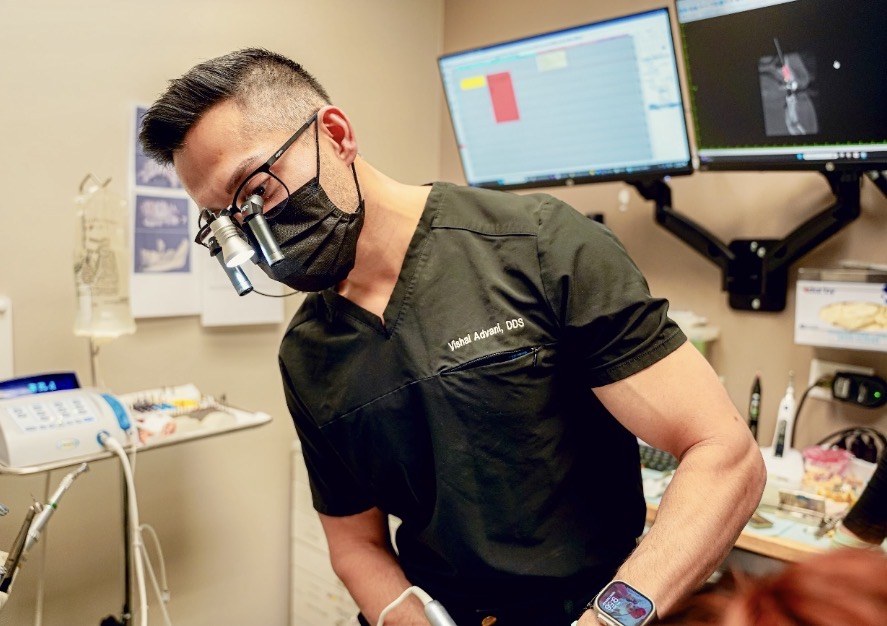
The ability to provide IV moderate sedation requires advanced sedation training and credentialing — including didactic coursework, supervised clinical experience, ACLS certification, and ongoing maintenance. Dr. Advani holds Illinois Permit A authorization and personally administers sedation at the Institute. Monitoring is performed by Dr. Advani together with a Surgical RN and IV-certified clinical staff throughout every procedure — a multi-person model that exceeds the staffing requirements of most office-based sedation practices.
IV sedation is recommended for any complex surgical procedure where comfort and absence of recall improve the patient experience and the surgical outcome.
Multiple implants, often combined with extractions, in a 3-4 hour procedure. IV sedation makes this comfortable for the patient and surgically efficient for the team.
Pterygoid, zygomatic, trans-sinus, palatal-approach implants — any procedure requiring extended surgical time benefits from sedation.
Patients with longstanding dental anxiety, fear of needles, or trauma history from past dental experiences. IV sedation often allows treatment that wouldn't otherwise be possible.
Patients with severe gag reflex find traditional dental treatment difficult or impossible. IV sedation eliminates the gag response during the procedure.
Patients with developmental disabilities or conditions that make extended awake dental treatment impractical. IV sedation, properly administered, is often the safest path to comprehensive care.
IV sedation is extremely safe when properly administered — but it's a real medical procedure, with real medications, that requires ongoing monitoring and the ability to respond to any complication. The setting matters.
The Advani Implant Institute operates inside Ascension Alexian Brothers Medical Center. Monitoring is performed by Dr. Advani working alongside a Surgical RN and IV-certified clinical staff throughout every procedure — multiple sets of trained eyes on the patient's vital signs at all times. Crash cart, supplemental oxygen, reversal agents, and full hospital-grade emergency response are immediately available. Any patient who needs a higher level of medical attention is on the same floor as cardiologists and emergency physicians, not across town.
For medically complex cases — patients with significant cardiac, respiratory, or neurological history — a Certified Registered Nurse Anesthetist (CRNA) is added to the surgical team. The CRNAs we work with bring extensive hospital, operating room, and ICU experience to the practice — credentials that allow safe sedation for cases that would otherwise require referral to a hospital surgical center. The decision to involve a CRNA is made at consultation based on each patient's specific medical history.
This is the standard of care that matters when something rare goes wrong. For most patients, sedation is uneventful. The Institute is built for the patients who need more than that.
Most patients are surprised by how simple and comfortable the experience is. Here's exactly what happens from arrival to discharge.
No food or drink (other than water) for 6 hours before your appointment. We'll review your medications and confirm any adjustments. Arrange for a driver — you cannot drive yourself home.
You're greeted, baseline vital signs are taken, and the IV is started — typically a small IV in the back of the hand. Nasal cannula provides supplemental oxygen. The clinical team connects monitoring equipment and reviews the sedation protocol with you.
Sedation medications are administered through the IV. Within 1-2 minutes, you're deeply relaxed and asleep. The surgical procedure proceeds while Dr. Advani and the clinical team monitor your vital signs continuously. Local anesthesia is also used to ensure complete absence of pain.
After the procedure, sedation is reversed. You'll be drowsy initially. Vital signs are monitored until you're awake enough to walk with assistance. Most patients have no memory of the surgery itself — just waking up in recovery.
Once you're stable and alert enough, your driver takes you home. You'll be drowsy for several hours and should rest. By the next morning, the sedation effects have fully worn off — most patients return to normal activities within 24-48 hours.
A complimentary consultation includes a discussion of which sedation approach is right for your specific procedure, medical history, and comfort preferences. There's no obligation, and you'll leave with a clear understanding of what the surgical experience will be like.